Every evening, thousands of cyclists set off on paths that were lit with the same logic as motorways — bright, always on, indifferent to whether anyone is actually there. For municipalities trying to balance safety, sustainability, and the protection of local ecosystems, that approach no longer holds up. There is a better way. And it starts with light that responds to the people who actually need it.
At Sustainder, we have built our smart lighting solutions around one guiding principle: the right light, in the right place, at the right moment. Nowhere is this more relevant — or more powerful — than on bicycle paths.
Why Bicycle Paths Demand a Dedicated Solution
Bicycle paths are not roads. They carry slower-moving, more vulnerable users. They often run along nature areas, waterways, and wildlife corridors. And unlike motorways, they are frequently empty — meaning traditional continuous lighting wastes energy illuminating nothing at all.
The challenge for municipalities is finding a system that can guarantee cyclist safety precisely when it is needed, while leaving the path dark and undisturbed when no one is there. That requires hardware purpose-built for the use case, not adapted from a generic street lighting product.
Sustainder has developed its luminaires — the Anne, Alexia, and Aspira — specifically with this in mind. Each is designed so that motion sensors can be seamlessly integrated, allowing the luminaire to respond intelligently to the presence of a cyclist or pedestrian. These are not afterthought add-ons. The sensor capability is built into the architecture of the luminaire from the ground up.
How the Motion-Sensing System Works
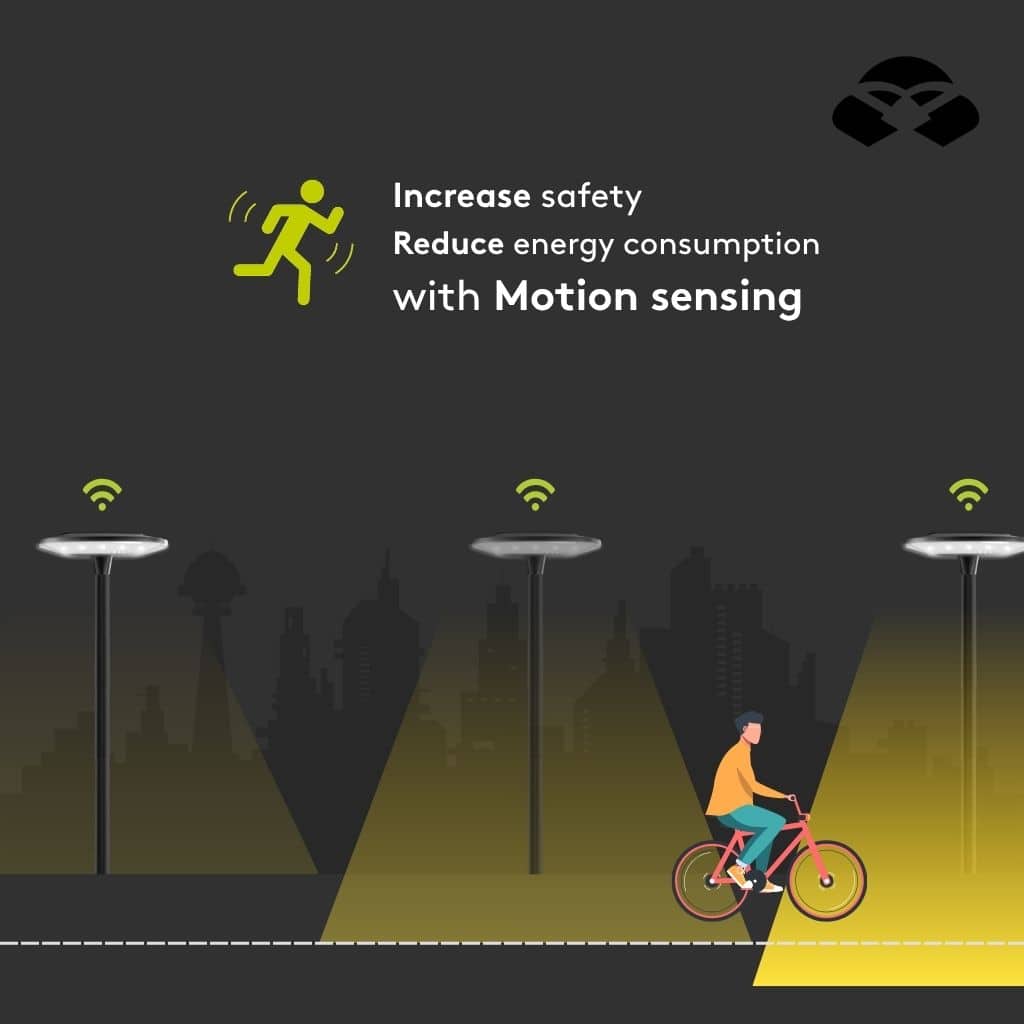
Sustainder uses a PIR (passive infrared) motion sensor integrated directly into the luminaire. When a cyclist approaches, the sensor detects movement and the luminaire ahead brightens to full intensity — illuminating the path in front of the rider. As the cyclist moves on, the lights behind gradually dim again, trailing the user like a moving bubble of light.
This “follow me” dynamic does two things simultaneously: it ensures the cyclist always has a well-lit path ahead, and it avoids the unnecessary energy consumption of keeping an entire route fully lit when only one section is in active use.
Some technical specifics worth noting for procurement decisions:
- Pole height compatibility: Sensors work optimally at pole heights between 3.5 and 6 metres
- Detection range: Approximately equal to the pole height plus one metre
- Maximum detection speed: Approximately 25 km/h — well-suited to cycling speed
- Minimum ambient light: Sustainder recommends maintaining a 5–10% baseline “orientation light” on all luminaires at all times, so cyclists never enter a completely dark section
- First and last luminaire always on: To ensure no cyclist enters the path into total darkness
- Remote configuration: All light intensity levels, switching times, and luminaire groupings can be configured and adjusted remotely — no physical intervention required
- The system is not one-size-fits-all. Settings are configured remotely by Sustainder after installation, and fully optimised for local conditions. If circumstances change, those settings can be updated accordingly — without sending a technician to site.
The Energy and Environmental Case
The impact on energy consumption is substantial. Sustainder’s motion detection solution delivers typical energy savings of 70–80% compared to conventional always-on lighting. When combined with Sustainder’s advanced dimming technology, total reductions of up to 95% are achievable.
This matters both financially and ecologically. Public lighting typically accounts for 30–50% of a municipality’s total public electricity consumption — making bicycle path lighting a significant cost centre that smart motion sensing can dramatically reduce.
Beyond the energy bill, there is a growing body of evidence that artificial light at night causes serious harm to biodiversity. Research from the Netherlands Institute of Ecology (NIOO-KNAW) demonstrates that light pollution significantly disrupts the behaviour and survival of nocturnal animals, including bats and insects that depend on darkness to forage, migrate, and reproduce. A literature study by the Instituut voor Natuur- en Bosonderzoek (INBO) similarly identifies light pollution as an underestimated environmental problem, affecting species across multiple taxonomic groups. Rijkswaterstaat has further documented how artificial light influences biological processes including reproduction, activity patterns, and the spatial distribution of both animals and plants.
Sensor-driven lighting directly addresses all of these concerns. When a bicycle path is only lit in the brief window that a cyclist is actually present, the surrounding habitat is left in the natural darkness that nocturnal wildlife depends on. Sustainder’s approach aligns with the emerging concept of bio-adaptive lighting — systems that dim, adjust colour temperature, or switch off entirely based on time, presence, and environmental context. It is a meaningful step toward infrastructure that coexists with nature rather than working against it.
The Safety Case: Visibility When It Counts
There is sometimes a perceived conflict between ecological sensitivity and public safety. Sustainder’s smart bicycle path lighting resolves that tension rather than forcing municipalities to choose.
Research and policy studies — including work by Platform31 — consistently show that well-lit public spaces are perceived as significantly safer, that visibility is central to how users experience their environment, and that poorly lit routes are actively avoided, particularly by women, older people, and younger cyclists. Sensor-triggered lighting addresses this directly: when a cyclist approaches a dark path and the lights respond automatically, the immediate effect is both practical (better visibility) and psychological (the environment feels responsive and inhabited, rather than abandoned).
Environmental psychology supports this too. People feel safer when they can read their surroundings and when that environment behaves predictably. A path that lights up ahead of you — and only ahead of you — communicates that the infrastructure is working for you.
The key distinction from traditional always-on lighting is that Sustainder’s system delivers targeted safety, not ambient illumination that benefits no one 80% of the time.
Data as a Management Tool
One underappreciated advantage of Sustainder’s motion-sensing system is the data it generates for municipal managers.
Because every trigger event is logged through the luminaire’s built-in connectivity, the system can provide quarterly performance dashboards that include:
- Real-time insight into the operational status of every luminaire
- Performance metrics for each individual motion sensor
- Traffic intensity estimates based on sensor trigger frequency — giving municipalities an approximation of actual cyclist volumes at different times of day and year
- Per-luminaire energy consumption data and calculated savings versus a baseline without motion sensing
- Maintenance and optimisation recommendations from Sustainder’s team
This transforms the bicycle path from passive infrastructure into a data source — one that can inform future investment decisions, route planning, and maintenance scheduling without any additional hardware investment.
The Sustainder Platform: GRIP
All of this is managed through GRIP, Sustainder’s proprietary management platform. GRIP provides a centralised interface for configuring dimming profiles, adjusting switching schedules, monitoring luminaire health, and accessing sensor data — all remotely.
This is important for municipalities managing hundreds or thousands of luminaires across a large area. The ability to adjust settings, respond to faults, and optimise performance without physical site visits is a significant operational efficiency. Sustainder luminaires automatically report defects, enabling maintenance teams to be dispatched only when and where they are actually needed.
Built on Open Architecture
Sustainder’s luminaires are built on a fully open architecture — open hardware (24V/230V), an open API, and open standards. This means municipalities are never locked into a proprietary ecosystem. As smart city ambitions grow — whether that means integrating air quality sensors, noise monitoring, traffic counting, or 5G connectivity — the modular cassette system means the luminaire infrastructure can grow with it.
This matters particularly for bicycle path projects that may start with motion sensing but evolve into broader smart city deployments. The foundation you invest in today does not need to be replaced tomorrow.
A Proven Track Record
Sustainder currently serves more than 250 municipalities across the Netherlands and Germany, with more than 100,000 smart luminaires installed across ten countries. The Anne, Alexia, and Aspira luminaire families — all motion-sensor compatible — have been recognised with the German Design Award (Alexia) and the Dutch Design Award (Aspira), reflecting both the technical and aesthetic quality of the product line.
The municipality of Hendrik-Ido-Ambacht, for example, achieved more than 85% energy savings after transitioning to Sustainder smart luminaires with remotely controlled dimming profiles.
The Right Partner for Bicycle Path Lighting
Bicycle path lighting is a specialist challenge. It requires luminaires engineered for lower mounting heights, sensor systems calibrated for cycling speeds, software capable of managing cascading light sequences, and a configuration service that can tune the system to the specific geometry of each path.
Sustainder has built all of this — not as a general street lighting company that also covers bicycle paths, but as a smart lighting partner with dedicated products, a proven methodology, and a decade of experience deploying exactly these kinds of solutions for municipalities across the Netherlands and beyond.
If your municipality is looking to upgrade its bicycle path infrastructure — improving safety for cyclists, reducing energy costs, protecting local biodiversity, and gaining real data on how your paths are actually used — we would be glad to show you what is possible.